
What Is a Gayborhood in 2026? Why Not Every Queer District Welcomes Every Queer Person
What is a gayborhood? Keith Givens on Boystown, WeHo and Dupont Circle versus Portland and Brooklyn—and what makes a queer district truly inclusive in 2026.
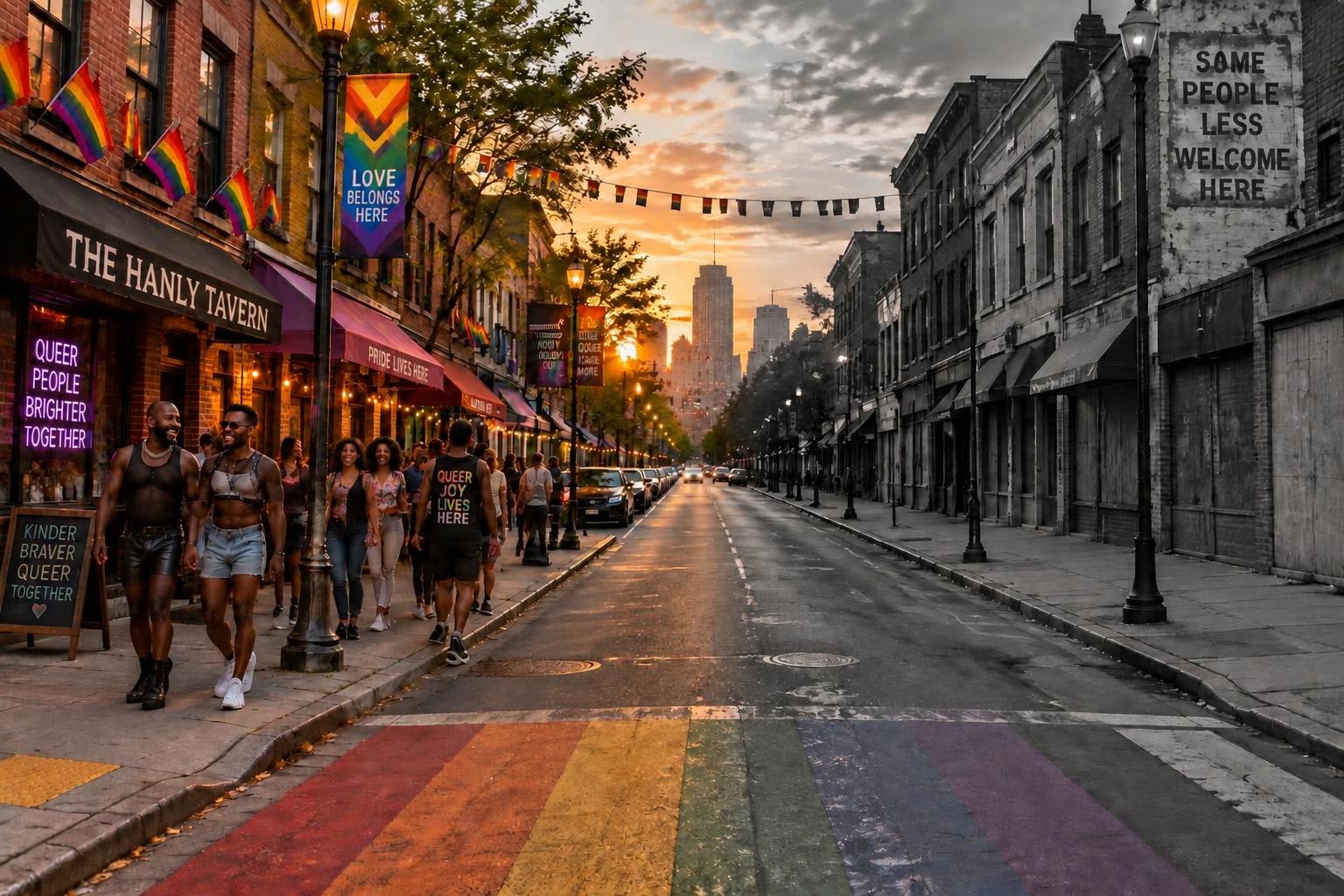
AI-generated editorial illustration; not a photograph of a real neighborhood, venue or people.
When people ask, “What is a gayborhood?”, the textbook answer paints a comforting picture: rainbow crosswalks, historic brick storefronts, street banners, and a dense strip of bars where anyone under the LGBTQ+ umbrella can live and celebrate without fear.
For first-time visitors, seeing that visible footprint feels like arriving in a sanctuary. But after decades of municipal commercialization and rising property values, travelers quickly encounter an unspoken reality: a neighborhood being designated “gay” does not automatically mean every queer person is welcome.
Across the country, there is a stark divide between gayborhoods that look pristine on a postcard while actively policing marginalized patrons, and genuinely inclusive districts that cultivate community safety for all races, gender presentations, and income levels.
The Legacy Enclave: The Cost and Contradiction of Boystown
In 1997, Chicago made history when Mayor Richard M. Daley officially designated a half-mile stretch of North Halsted in East Lakeview as the nation’s first officially recognized gay village: Boystown.
It was celebrated as a monumental civic milestone. Yet over the following two decades, Boystown evolved into one of the city’s most affluent, homogenous pockets. As real estate values skyrocketed, the neighborhood’s commercial core increasingly prioritized wealthy, cisgender white gay men, while treating young Black and brown queer people—who relied on the Red Line to access community resources at the Center on Halsted—with visible suspicion.
Neighborhood associations and business alliances routinely demanded heavier police patrols and private security along the strip. Venues quietly instituted arbitrary dress codes targeting urban fashion, while spots like Progress Bar openly attempted to ban hip-hop to alter customer demographics. The community pushback was fierce: years of grassroots demonstrations, town halls, and direct actions eventually compelled the local business alliance to rebrand the strip as “Northalsted” in 2020.
Yet the underlying lesson remained clear: an area code can fly a rainbow flag while weaponizing classism and racism against its own community.
Chicago is not an isolated case. In Los Angeles, West Hollywood (WeHo) has long faced criticism for high-end door policies, VIP pricing, and aggressive street policing that alienate Black, Latino, and working-class queer youth. In Washington, D.C., Dupont Circle experienced rapid gentrification that priced out independent queer spaces, pushing community organizing eastward.
The Contrast: True Inclusivity in Portland and Brooklyn
True inclusivity doesn’t thrive because of municipal proclamations or corporate street banners; it survives because of intentional community accountability.
Take Portland, Oregon. Portland’s queer landscape rarely confines itself to a single, monolithic avenue. Instead of a gated commercial corridor, the city’s queer scene flourishes across the Central Eastside, Hawthorne, and Belmont. Spaces here operate on a fundamentally different social blueprint:
- Decentralized Third Places: Rather than relying exclusively on alcohol-driven megaclubs, daytime queer-owned coffee shops, community bookstores, and cooperative makerspaces anchor the neighborhoods.
- Affirming Door Dynamics: Venues prioritize explicit community agreements at the door—centering trans, non-binary, and BIPOC patrons, keeping cover charges accessible, and maintaining sober options as standard practice rather than an afterthought.
- Radical Inclusivity: The culture values mutual aid and political action over high-gloss consumerism.
You find a parallel dynamic in Brooklyn, New York (particularly across Crown Heights, Bed-Stuy, and Bushwick). Unlike the historic, corporate-heavy bars of Manhattan’s West Village, Brooklyn’s independent venues and collective parties center Black and brown queer artists, grassroots promoters, and multidisciplinary nightlife that doesn’t price out the community that built it.
Redefining the Gayborhood in 2026
So, what makes a true queer enclave today?
| Feature | The Legacy “Pristine” Strip | The Inclusive Modern Enclave |
|---|---|---|
| Footprint | Single commercial strip (Halsted, Santa Monica Blvd) | Decentralized micro-districts & cultural pockets |
| Demographics | Affluent, predominantly cisgender & white | Multi-racial, gender-expansive, multi-generational |
| Door Policy | Restrictive dress codes, high covers, security-heavy | Clear community guidelines, accessible sliding scale |
| Economy | Corporate real estate & nightlife conglomerates | Independent operators, queer daytime anchors, mutual aid |
A genuine safe haven is never measured by how neat the sidewalks look or how many corporate sponsorships line the lamp posts. It is measured by who feels safe walking down the block at 2:00 AM, who feels dignified at the front door, and whether every member of our diverse family can afford to be in the room.
Before you plan your next trip based on an outdated travel guide, look beyond the rainbow paint. The future of queer community isn’t living in an exclusive past—it is being built wherever all of us are protected and celebrated.
Looking for verified neighborhood safety scores, authentic district breakdowns, and real-time community spaces across 25+ cities? Explore the city guides and the interactive map in The Queer Route app.
Download The Queer Route.
Real-time, community-verified safe spaces — built by us, for us. Now live in Austin & beyond.
Keep reading
Beyond the Harness: What Black Leather Culture Looks Like in Community
Keith Givens interviews leatherbrother Antonio Abernathy on Black leather culture: brotherhood, pledge lines, community service, and what stereotypes miss.
Travel Tips & Safety | Founder’s NoteThe “Closet-Cation” Reality: Why 40% of Queer Travelers Still Step Back Into the Closet in 2026
Roughly 40% of LGBTQ+ travelers change how they dress or act to feel safe. Keith Givens on the closet-cation, the $4.7T queer economy, and street-level safety.
Travel Tips & SafetyHow to Read a City’s Queer Nightlife Like an Insider: 4 Signals That Matter More Than Google Reviews
Star ratings don’t tell you who’s in the room. Four insider signals for queer nightlife: promoters and DJs, micro-districts, daily programming, and community-verified safety.
Neighborhoods & Queer Culture | Founder’s NoteFinding the Vibe: Is Luxx Quietly Becoming 4th Street’s Hidden Black Queer Gem?
Keith Givens reflects on a Saturday night at Luxx in Austin, where contemporary R&B, Black and brown queer community, and a welcoming room sparked a question about 4th Street’s nightlife.
Neighborhoods & Queer CultureThe Texas Triangle: How Dallas, Austin, and Houston Built Three Completely Different Queer Worlds
Dallas vs Austin vs Houston gay nightlife: how Oak Lawn's strip, Austin's independent rooms, and Houston's unzoned sprawl and hospitality collectives shaped three queer scenes.
Outdoor Travel & SafetyGay Camping & Retreats: The Ultimate Guide to Unplugging, Community, and Safe Ground
A guide to gay camping and queer retreats: festival gatherings like Frolic, LGBTQ+ campgrounds, sober eco-retreats, first-timer tips, and rural travel safety.
Neighborhoods & Queer CultureThe Crossroads Playbook: How Oak Lawn Built a Daylight Sanctuary That Defied Texas Politics
Explore Cedar Springs and Dallas’s Oak Lawn gayborhood: Hunky’s daytime community roots, iconic gay bars, and an intentional walking route through The Crossroads.
Community SpotlightBeyond the Perimeter: Inside BTC, the Groundbreaking LGBTQ+ Sanctuary Thriving Behind Tennessee Prison Walls
Keith Givens interviews BTC founder Varia about LGBTQIA+ community behind Tennessee prison walls, safe spaces, leadership, and meaningful outside solidarity.
Queer Culture & Spatial SafetyThe Sanctuary of the Mask: Why Halloween Is Gay Christmas (and How to Navigate the Nation's Biggest Street Parties Safely)
Why Halloween is Gay Christmas: the history of queer costume as survival, plus safety logistics for the Oak Lawn block party, Haunted Halsted, Fantasy Fest, and the WeHo Carnaval.
Queer Culture & Spatial SafetyTwo Continents, One Towel: The Reality, Etiquette, and Safety of Gay Bathhouses in the U.S. vs. Abroad
What happens in a gay bathhouse? A practical guide to bathhouse etiquette, safety, consent, and the cultural differences between U.S. clubs and European saunas.
City SpotlightsOnly in Portland: 3 Queer Experiences You Won't Find Anywhere Else in the Country
Trans-centered bathhouses, a deep ecosystem of sober queer third places, and sex-positive community wellness — three Portland experiences you can't get anywhere else in the U.S.
Queer Culture & Spatial SafetyBeyond the Stereotypes: How Tech, Consent, and Culture Redefined Gay Cruising
Cruising is one of the most resilient practices in gay culture and one of the most stigmatized. A look at how map-based apps, consent, and community norms reshaped it.
CruisesGay Cruises: The Ultimate First-Timer's Guide to Sailing Proud
A first-timer's guide to gay cruises: Atlantis vs. VACAYA, full-ship charters vs. group sailings, theme parties, solo travel, and the safety rules that matter at sea and in port.
Atlanta PrideThe Ultimate Atlanta Pride Guide: History, Local Culture, and Safe Routing
Atlanta Pride guide for LGBTQ+ travelers: why Pride happens in October, where to go in Midtown and EAV, how to use MARTA, and safety routing around Piedmont Park.
Global Safety & Economic PowerLegal on Paper, Targeted in Reality: From Istanbul to the U.S., Safe Spaces Are Under Siege
Turkey's 1 AM raids on gay bars and the escalating attacks on queer spaces in the U.S. share one message: legality is not safety. Why verified safe spaces — and the $3.9 trillion Pink Dollar — are our strongest defense.
International travelThe Queer Route Is the Safe Haven for Queer Travelers
LGBTQ+ travel safety in the Bahamas, Jamaica, and South Africa: the laws, the risks, the underground queer joy, and how community-verified safe spaces give Black and brown travelers a route to sanctuary abroad.
Safety5 Ways to Detect Danger at a Gay Bar or Club
LGBTQ+ nightlife safety guide: 5 ways to spot danger early at a gay bar or club, defuse tension, leave safely, and use the Follow Me tool to confirm your friends get home.
CommunityWhat Does a Real Gay Ecosystem Look Like?
The Pink Dollar is worth trillions, but most gay travel sites just harvest affiliate commissions. Here's what a real queer economic ecosystem looks like — and how QR Certified venues keep our money circulating in our own community.
Budget travelBreaking the Poverty Mindset: Why Every Queer Person Deserves a Reset (Even on a Budget)
Budget LGBTQ+ travel guide: 5 ways to beat the poverty mindset, plan cheap queer micro-getaways, find free safe spaces, and build a reset fund — rest isn't a luxury for the top tax bracket.
CommunityWhat We Have Become
Media that trades in fear and stereotype has real consequences on the streets we walk. On Run, Hide, Fight: Infidels, harmful tropes, and why intersectional safety means standing with Muslim, Black, and brown communities.
CommunityIf It Ain't Broke...
Historic LGBTQ+ bars are changing hands across the country. When new ownership reinvents the wheel, the regulars pay for it. On modernizing legacy queer spaces without erasing the community that built them.
City SpotlightBeyond History: How San Francisco's Transgender District is Redefining Queer Space & Economic Power
Explore the untold story of San Francisco's Transgender District — from dropping Gene Compton's name to building trans economic power and business ownership in the Tenderloin.
CommunityWill They Ever Learn?
Texas painted over Austin's rainbow Pride crosswalk. Paint fades — we don't. On political erasure, the $4.7 trillion Pink Dollar, and why we built our own map.
TravelTop Three U.S Cities Queer Families Should Visit
Queer parents deserve family destinations where their family structure is respected, visible, and celebrated. Here are three U.S. cities that deliver inclusive communities and standout attractions.
CommunityWhy Do Some Cities Have Black Pride and National Pride?
Black Pride was never about dividing us — it was a declaration that we are here, too. A look at how Pride Season came to be, and why tailored celebrations still matter.
Vendor SpotlightVendor Spotlight: Whip My Soul
A Black-owned soul food restaurant in Austin that treats hospitality like a craft. Here's why Whip My Soul belongs at the top of your list — and exactly what to order.
CompanyWhy We Built The Queer Route: The Founder's Story
I built the app I needed — from a 9-to-5 and a paycheck. Keith Givens on why the LGBTQ+ community needed its own navigation platform.
Travel GuidesHow to Find LGBTQ+ Safe Spaces When Traveling in 2026
Beyond the rainbow flag: a real-time, community-verified guide to finding truly safe spaces on the road in 2026.
Safety6 Green Flags That Signal a Truly LGBTQ+ Friendly Venue
A Progress Pride sticker in the window isn't enough anymore. Here are the real indicators that a bar, café, or hotel is genuinely safe, inclusive, and built for our community — and how to spot them before you step inside.
Find safe spaces in these cities
Community-verified LGBTQ+ guides to bars, nightlife, and neighborhoods.