
Beyond the Harness: What Black Leather Culture Looks Like in Community
Keith Givens interviews leatherbrother Antonio Abernathy on Black leather culture: brotherhood, pledge lines, community service, and what stereotypes miss.
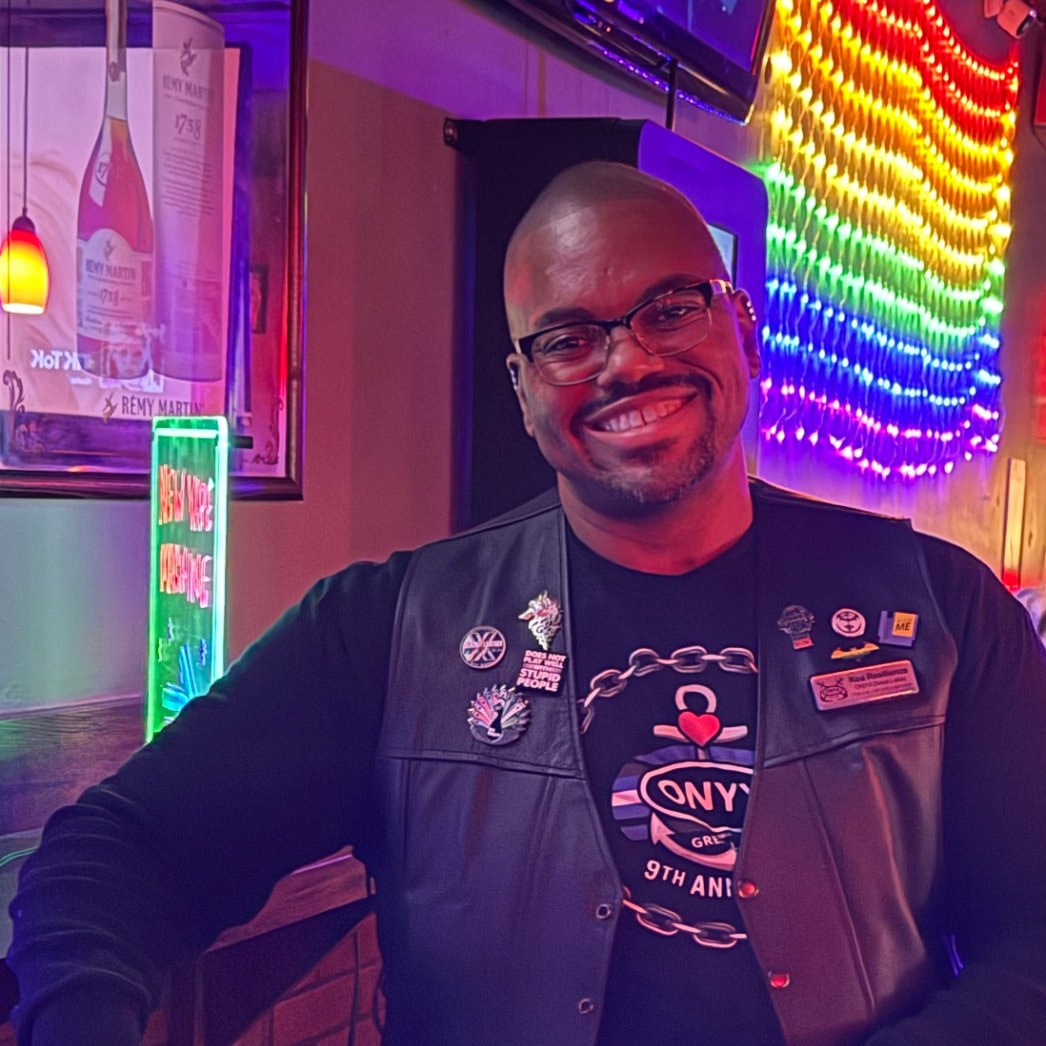
Antonio Abernathy in his ONYX vest. Photo courtesy of Keith Givens.
When mainstream media or everyday bar patrons think of the leather community, the imagery often stops at the surface: heavy hides, chest harnesses, dark backrooms, and assumptions rooted strictly in sex. For decades, popular culture has flattened kink subcultures into one-dimensional tropes, completely overlooking the civic organization, mutual aid, and intentional brotherhood that sustain these spaces.
For Black queer men, navigating leather culture adds another layer of depth. In an LGBTQ+ landscape where spaces can frequently feel fractured or isolating, finding a room where you can fully explore your identity without judgment or performative expectations is rare. Within Black leather organizations, leather is not just gear—it is a discipline, a shared lineage, and a profound vehicle for chosen family.
To unpack what this looks like in practice, I sat down with Antonio Abernathy—an active leatherbrother who crossed into his leather fraternity in 2024—to discuss brotherhood, breaking stereotypes, and why community service sits at the heart of the lifestyle.
The Beginning: From Solitude to the First Harness
Keith Givens: What first drew you to the leather community, and what made you decide it was a space where you wanted to stay involved?
Antonio Abernathy: “It was 2020 in the early part of the pandemic that piqued my interest in the leather community. Since we were under quarantine and seeing one of my now leather brothers’ X pages as I was trying to find new methods of getting off since hookups were not an option at that time. That was when I ordered my first harness from Adam 4 Adam. I have since then been adding to my leather and kink collection.”
The Spatial Takeaway: The Isolation Gateway
Antonio’s introduction mirrors how many people found community during the lockdowns of 2020. When physical gathering spaces shuttered, digital spaces became laboratories for personal exploration. What begins as curiosity often turns into a search for deeper belonging once physical venues reopen.
Redefining Representation: Safety Without Awkwardness
Keith Givens: As a Black man in leather, what does community look like to you—both within leather spaces and in the broader LGBTQ+ community?
Antonio Abernathy: “Being a Black man in leather, community has looked more like seeing other people that look like me and have similar interests that I have, whether it is leather and kink, or your everyday common interests and hobbies. In a broader sense, I see all races, ethnicities, and genders in the LGBTQ+ community that are also within the leather community, expressing themselves without feeling awkward or judged. Also, for many, it’s the feeling of safety and acceptance.”
The Spatial Takeaway: Freedom from the Gaze
In conventional nightlife, Black queer men often navigate double standards—scrutinized at the door or boxed into narrow archetypes. Antonio points out that intentional leather environments invert that dynamic: when spaces are built around shared consent, discipline, and identity, the friction disappears. You aren’t just tolerated; you are among peers sharing common ground.
The Pledge Line: Brotherhood as Infrastructure
Keith Givens: You have become very involved in a relatively short time. What has helped you find your place, build relationships, and contribute?
Antonio Abernathy: “I pledged and crossed over into my leather fraternity back in 2024. What helped me find my place is knowing what you want out of your leather journey. One thing I know I wanted was another form of brotherhood as cliché as it sounds, but you are siblings from the moment you’re accepted onto the pledge line to the time you crossover into the organization.
“In my leather journey, I have learned about myself more and more that eventually you find your place. For myself, I look to eventually go into mentorship for new pledges while teaching along the way whether it’s giving a class or an impromptu demonstration, or doing some type of community service within our chapter.”
The Spatial Takeaway: Traditions of Service
The pledge process within Black leather fraternities (such as ONYX and its regional chapters) carries a rich legacy that mirrors civic organizations and historically Black fraternities. It demands accountability, historical literacy, and community reinvestment. Far from being passive social clubs, these chapters coordinate charity drives, fund health initiatives, and mentor newcomers, anchoring the community long after the bar lights turn on.
Debunking the Myth: Sex Drives, But Brotherhood Anchors
Keith Givens: What do you wish more people understood about Black leather culture beyond the stereotypes they may see online or in popular media?
Antonio Abernathy: “One thing that I wish others understood about Black leather culture beyond assumed stereotypes is that the main purpose isn’t sex. Sex can drive it—everyone has sex—but it is a brotherhood, and bonds occur inside and outside of our leather events and bars. But in the same instance, you can come as you are because many usually turn their nose up at leather and kink groups and want to classify it as one big orgy when that is far from reality.”
The Spatial Takeaway: De-Sensationalizing Kink
Society routinely sexualizes Black bodies while trivializing their social bonds. Antonio cuts through the sensationalism: while eroticism and kink expression are valid facets of the culture, the glue that keeps members active year after year is mutual respect, daily check-ins, and emotional sanctuary outside the venue.
Stepping Through the Door: Advice for the Curious
Keith Givens: For a Black queer person who is curious about leather but may feel intimidated or unsure where they fit, what would you want them to know before taking that first step?
Antonio Abernathy: “A Black queer person that is curious, I would recommend researching leather history, particularly Black leather history, to get a full gist. It couldn’t hurt to go to a leather gear shop to feel the gear and try it on, just to have a feeling of what it’s like to wear it.
“I would also recommend going to a leather bar or leather-themed events at bars. There you can get exposure to seeing other Black queer persons in leather and possibly demonstrating their favorite kinks and fetishes. You’d be surprised as to who participates in the leather community after clocking out of their 9-to-5 position for those who are curious, but are concerned about their professional image. And lastly, but certainly not least, ask someone you know who is part of the leather community.”
The Reality Behind the Vest
Antonio’s perspective reminds us that safe harbors in our community take many forms. A leather vest adorned with chapter pins and patches is not just an aesthetic statement—it represents a resume of community service, education, and shared vulnerability.
The corporate world often forces Black queer men to compartmentalize their lives, balancing professional respectability against personal expression. Within intentional leather and kink spaces, that performance drops. Whether you are a corporate manager by day or a newcomer trying on your first harness, the door opens with a simple baseline: respect the history, honor the boundaries, and show up for your brothers.
Looking for verified leather bars, community spaces, and inclusive nightlife corridors across the country? Explore vetted safe harbors in our city guides, and download The Queer Route.
Download The Queer Route.
Real-time, community-verified safe spaces — built by us, for us. Now live in Austin & beyond.
Keep reading
What Is a Gayborhood in 2026? Why Not Every Queer District Welcomes Every Queer Person
What is a gayborhood? Keith Givens on Boystown, WeHo and Dupont Circle versus Portland and Brooklyn—and what makes a queer district truly inclusive in 2026.
Travel Tips & Safety | Founder’s NoteThe “Closet-Cation” Reality: Why 40% of Queer Travelers Still Step Back Into the Closet in 2026
Roughly 40% of LGBTQ+ travelers change how they dress or act to feel safe. Keith Givens on the closet-cation, the $4.7T queer economy, and street-level safety.
Travel Tips & SafetyHow to Read a City’s Queer Nightlife Like an Insider: 4 Signals That Matter More Than Google Reviews
Star ratings don’t tell you who’s in the room. Four insider signals for queer nightlife: promoters and DJs, micro-districts, daily programming, and community-verified safety.
Neighborhoods & Queer Culture | Founder’s NoteFinding the Vibe: Is Luxx Quietly Becoming 4th Street’s Hidden Black Queer Gem?
Keith Givens reflects on a Saturday night at Luxx in Austin, where contemporary R&B, Black and brown queer community, and a welcoming room sparked a question about 4th Street’s nightlife.
Neighborhoods & Queer CultureThe Texas Triangle: How Dallas, Austin, and Houston Built Three Completely Different Queer Worlds
Dallas vs Austin vs Houston gay nightlife: how Oak Lawn's strip, Austin's independent rooms, and Houston's unzoned sprawl and hospitality collectives shaped three queer scenes.
Outdoor Travel & SafetyGay Camping & Retreats: The Ultimate Guide to Unplugging, Community, and Safe Ground
A guide to gay camping and queer retreats: festival gatherings like Frolic, LGBTQ+ campgrounds, sober eco-retreats, first-timer tips, and rural travel safety.
Neighborhoods & Queer CultureThe Crossroads Playbook: How Oak Lawn Built a Daylight Sanctuary That Defied Texas Politics
Explore Cedar Springs and Dallas’s Oak Lawn gayborhood: Hunky’s daytime community roots, iconic gay bars, and an intentional walking route through The Crossroads.
Community SpotlightBeyond the Perimeter: Inside BTC, the Groundbreaking LGBTQ+ Sanctuary Thriving Behind Tennessee Prison Walls
Keith Givens interviews BTC founder Varia about LGBTQIA+ community behind Tennessee prison walls, safe spaces, leadership, and meaningful outside solidarity.
Queer Culture & Spatial SafetyThe Sanctuary of the Mask: Why Halloween Is Gay Christmas (and How to Navigate the Nation's Biggest Street Parties Safely)
Why Halloween is Gay Christmas: the history of queer costume as survival, plus safety logistics for the Oak Lawn block party, Haunted Halsted, Fantasy Fest, and the WeHo Carnaval.
Queer Culture & Spatial SafetyTwo Continents, One Towel: The Reality, Etiquette, and Safety of Gay Bathhouses in the U.S. vs. Abroad
What happens in a gay bathhouse? A practical guide to bathhouse etiquette, safety, consent, and the cultural differences between U.S. clubs and European saunas.
City SpotlightsOnly in Portland: 3 Queer Experiences You Won't Find Anywhere Else in the Country
Trans-centered bathhouses, a deep ecosystem of sober queer third places, and sex-positive community wellness — three Portland experiences you can't get anywhere else in the U.S.
Queer Culture & Spatial SafetyBeyond the Stereotypes: How Tech, Consent, and Culture Redefined Gay Cruising
Cruising is one of the most resilient practices in gay culture and one of the most stigmatized. A look at how map-based apps, consent, and community norms reshaped it.
CruisesGay Cruises: The Ultimate First-Timer's Guide to Sailing Proud
A first-timer's guide to gay cruises: Atlantis vs. VACAYA, full-ship charters vs. group sailings, theme parties, solo travel, and the safety rules that matter at sea and in port.
Atlanta PrideThe Ultimate Atlanta Pride Guide: History, Local Culture, and Safe Routing
Atlanta Pride guide for LGBTQ+ travelers: why Pride happens in October, where to go in Midtown and EAV, how to use MARTA, and safety routing around Piedmont Park.
Global Safety & Economic PowerLegal on Paper, Targeted in Reality: From Istanbul to the U.S., Safe Spaces Are Under Siege
Turkey's 1 AM raids on gay bars and the escalating attacks on queer spaces in the U.S. share one message: legality is not safety. Why verified safe spaces — and the $3.9 trillion Pink Dollar — are our strongest defense.
International travelThe Queer Route Is the Safe Haven for Queer Travelers
LGBTQ+ travel safety in the Bahamas, Jamaica, and South Africa: the laws, the risks, the underground queer joy, and how community-verified safe spaces give Black and brown travelers a route to sanctuary abroad.
Safety5 Ways to Detect Danger at a Gay Bar or Club
LGBTQ+ nightlife safety guide: 5 ways to spot danger early at a gay bar or club, defuse tension, leave safely, and use the Follow Me tool to confirm your friends get home.
CommunityWhat Does a Real Gay Ecosystem Look Like?
The Pink Dollar is worth trillions, but most gay travel sites just harvest affiliate commissions. Here's what a real queer economic ecosystem looks like — and how QR Certified venues keep our money circulating in our own community.
Budget travelBreaking the Poverty Mindset: Why Every Queer Person Deserves a Reset (Even on a Budget)
Budget LGBTQ+ travel guide: 5 ways to beat the poverty mindset, plan cheap queer micro-getaways, find free safe spaces, and build a reset fund — rest isn't a luxury for the top tax bracket.
CommunityWhat We Have Become
Media that trades in fear and stereotype has real consequences on the streets we walk. On Run, Hide, Fight: Infidels, harmful tropes, and why intersectional safety means standing with Muslim, Black, and brown communities.
CommunityIf It Ain't Broke...
Historic LGBTQ+ bars are changing hands across the country. When new ownership reinvents the wheel, the regulars pay for it. On modernizing legacy queer spaces without erasing the community that built them.
City SpotlightBeyond History: How San Francisco's Transgender District is Redefining Queer Space & Economic Power
Explore the untold story of San Francisco's Transgender District — from dropping Gene Compton's name to building trans economic power and business ownership in the Tenderloin.
CommunityWill They Ever Learn?
Texas painted over Austin's rainbow Pride crosswalk. Paint fades — we don't. On political erasure, the $4.7 trillion Pink Dollar, and why we built our own map.
TravelTop Three U.S Cities Queer Families Should Visit
Queer parents deserve family destinations where their family structure is respected, visible, and celebrated. Here are three U.S. cities that deliver inclusive communities and standout attractions.
CommunityWhy Do Some Cities Have Black Pride and National Pride?
Black Pride was never about dividing us — it was a declaration that we are here, too. A look at how Pride Season came to be, and why tailored celebrations still matter.
Vendor SpotlightVendor Spotlight: Whip My Soul
A Black-owned soul food restaurant in Austin that treats hospitality like a craft. Here's why Whip My Soul belongs at the top of your list — and exactly what to order.
CompanyWhy We Built The Queer Route: The Founder's Story
I built the app I needed — from a 9-to-5 and a paycheck. Keith Givens on why the LGBTQ+ community needed its own navigation platform.
Travel GuidesHow to Find LGBTQ+ Safe Spaces When Traveling in 2026
Beyond the rainbow flag: a real-time, community-verified guide to finding truly safe spaces on the road in 2026.
Safety6 Green Flags That Signal a Truly LGBTQ+ Friendly Venue
A Progress Pride sticker in the window isn't enough anymore. Here are the real indicators that a bar, café, or hotel is genuinely safe, inclusive, and built for our community — and how to spot them before you step inside.
Find safe spaces in these cities
Community-verified LGBTQ+ guides to bars, nightlife, and neighborhoods.